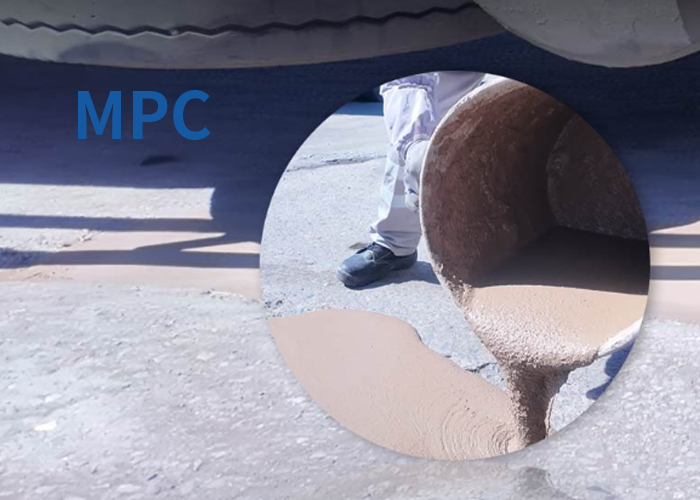
Magnesium Phosphate Cement for Fast Infrastructure Repair High-Performance Rapid Setting Binder for Global Procurement Projects
For infrastructure procurement teams and engineering contractors, material selection is no longer only a technical decision—it is a cost, downtime, and project efficiency decision.
In emergency repair scenarios such as airport runways, highway bridges, and industrial flooring systems, traditional Ordinary Portland Cement (OPC) is no longer sufficient due to its slow strength development and long curing cycle.
Magnesium Phosphate Cement (MPC) has become a preferred solution for fast-track repair projects because it enables structural reopening within hours instead of days, significantly reducing operational downtime and economic losses.
Why Magnesium Phosphate Cement Is Replacing Conventional Repair Systems
Unlike OPC hydration systems, Magnesium phosphate cementitious material is based on an acid–base reaction between magnesium oxide and phosphate compounds. This creates a dense crystalline matrix that develops high early strength at ambient temperature.
Compared with traditional cementitious systems, Phosphate cement delivers:
Extremely fast return-to-service time
High early compressive strength
Strong adhesion to old concrete
Minimal shrinkage cracking
No curing requirement (no steam or heat curing needed)
For procurement teams, the key value is not only performance—but downtime reduction and lifecycle cost savings.
Commercial Advantages for Procurement Teams
1. Cost Advantage (Downtime Reduction Value)
In infrastructure projects, the real cost driver is not material price—it is closure time.
With Magnesium Phosphate Cement, many repair sections can be reopened within 2–4 hours, compared to 24–48 hours for OPC systems.
This results in:
Reduced airport/road closure penalties
Lower labor and equipment standby costs
Increased operational uptime for facilities
Higher ROI per repair project
In many cases, the economic savings from reduced downtime exceed material costs by several times.
2. Procurement Advantage (Stable Supply & Fast Delivery)
From a global sourcing perspective, Magnesium phosphate cementitious material offers strong procurement flexibility:
Available in bulk industrial powder form
Easy storage and long shelf stability
No special handling or refrigeration required
Suitable for containerized international shipping
Stable formulation suitable for large-scale projects
For contractors and distributors, this ensures predictable supply chains and project continuity.
3. Packaging & Export Advantage
To support international construction markets, Phosphate cement is typically supplied in:
25kg moisture-resistant bags
1-ton jumbo bags (FIBC)
Palletized export packaging for container loading
Export-ready packaging ensures:
Safe long-distance transportation
Reduced moisture risk during shipping
Efficient warehouse handling and distribution
This makes it suitable for EPC contractors, infrastructure distributors, and government procurement projects.
Comparison: MPC vs Epoxy & Polymer Repair Systems
While epoxy and polymer-based systems are widely used in repair engineering, they have limitations in large-scale infrastructure applications.
| Performance Factor | Epoxy/Polymer Systems | Magnesium Phosphate Cement |
|---|---|---|
| Moisture tolerance | Poor (surface must be dry) | Excellent (SSD condition acceptable) |
| Fire resistance | Limited | High inorganic stability |
| Temperature sensitivity | High | Stable -10°C to +50°C |
| Early load capacity | Medium | Very high (2–4 hours opening) |
| Field application speed | Moderate | Very fast |
| Cost efficiency in large area repair | High cost | More economical |
Unlike organic resin systems, Magnesium Phosphate Cement is inorganic and non-flammable, making it more suitable for infrastructure safety-critical environments.
Typical Application Value in Real Projects
Airport Runway Emergency Repair
Reopen in 2–4 hours
Avoid flight delay penalties
Reduce operational disruption
Highway & Bridge Deck Repair
Minimize lane closure time
Reduce traffic congestion costs
Improve maintenance efficiency
Industrial Floor Restoration
Food processing plants
Pharmaceutical facilities
Logistics warehouses
→ Avoid production shutdown losses
Supply Capability & Cooperation Scope
We support global procurement projects with:
Stable industrial-scale production capacity
Technical formulation adjustment for different climates
Retarder and working time customization
OEM/private label supply options
Technical support for engineering applications
Whether you are a distributor, contractor, or infrastructure project owner, Magnesium phosphate cementitious material can be adapted to your local construction standards and environmental conditions.
Technical Application Support
To ensure optimal performance on-site, we also provide:
Working time adjustment guidance (hot/cold climate adaptation)
Mix ratio optimization for different aggregates
Compatibility evaluation with local materials
On-site troubleshooting support for large projects
This ensures Phosphate cement performs consistently across different global construction environments.
Conclusion
As infrastructure projects move toward faster execution cycles and higher efficiency requirements, traditional repair materials are no longer sufficient.
Magnesium Phosphate Cement provides a new generation solution combining:
Rapid strength development
Strong durability
Excellent field adaptability
Significant downtime reduction value
For procurement teams, its real advantage is not only technical performance—but measurable economic efficiency in infrastructure repair operations.
Contact for Inquiry, Pricing & Samples
For technical data sheets, commercial quotations, or project-specific procurement support, please contact us:
📧 Email: marketing@eschemy.com
We also supply related construction chemical systems, including polycarboxylate superplasticizer (PCE) admixtures, to support optimized concrete workability and performance in hybrid repair systems.