Magnesium Phosphate Cement (MPC): Fast-Setting Cementitious Material for Infrastructure Repair, Industrial Flooring & Specialty Construction
Magnesium phosphate cement (MPC) has emerged as one of the most compelling advances in construction chemistry over the past three decades. Unlike conventional Portland cement, which depends on calcium silicate hydration and requires hours or even days to achieve structural strength, magnesium phosphate cement develops high early compressive strength through a rapid acid-base exothermic reaction between dead-burned magnesia (MgO) and soluble phosphate compounds — typically monopotassium phosphate (KH₂PO₄). The outcome is a fast-setting cementitious material capable of exceeding 20 MPa within one to two hours of placement, making MPC a decisive choice wherever rapid return-to-service is required.
From airport runway emergency repairs and highway bridge deck rehabilitation to nuclear waste encapsulation and industrial flooring restoration, MPC systems are steadily displacing conventional construction chemicals in applications where downtime carries unacceptable operational or economic costs. This guide covers the chemistry, performance profile, key applications, raw material specifications, and sourcing considerations for magnesium phosphate cement, drawing on the specialty chemical expertise of ES CHEM Co., Ltd.
1. The Chemistry Behind Magnesium Phosphate Cement
The setting mechanism of magnesium phosphate cement is fundamentally different from Portland cement hydration. When dead-burned magnesia is blended with a soluble phosphate source and water, a rapid acid-base neutralization occurs, producing struvite-K (MgKPO₄·6H₂O) as the primary crystalline binding phase:
MgO + KH₂PO₄ + 5H₂O → MgKPO₄·6H₂O
This reaction is strongly exothermic, releasing heat quickly and driving the fast-setting cementitious material behavior that defines all MPC systems. The resulting struvite crystal matrix is dense, low in porosity, and chemically stable across a wide pH range — properties that underpin magnesium phosphate cement's durability in demanding service environments.
Four parameters govern MPC performance: the molar ratio of MgO to phosphate (M/P ratio, typically 3:1–5:1); the reactivity of the magnesia source (determined by calcination temperature and specific surface area); the type and dosage of retarder (typically borax, Na₂B₄O₇·10H₂O, at 5–10 wt% of MgO) used to extend workable life; and the water-to-binder ratio. Optimizing these variables allows engineers to tailor the setting time, working time, and mechanical performance of a fast-setting cementitious material system to the precise demands of each application.
2. Performance Comparison: MPC vs. Ordinary Portland Cement
The growing adoption of magnesium phosphate cement across the construction and infrastructure sectors reflects a set of performance advantages that conventional construction chemicals cannot replicate:
| Performance Parameter | Magnesium Phosphate Cement | Ordinary Portland Cement |
| Initial set time | 5–30 min (adjustable) | 45–120 min |
| Compressive strength at 1 hour | 15–30 MPa | < 5 MPa |
| Compressive strength at 28 days | 50–80 MPa | 30–50 MPa |
| Bond strength to existing concrete | 2.0–4.0 MPa | 1.0–2.0 MPa |
| Drying shrinkage | Near-zero or slight expansion | Moderate shrinkage |
| Operating temperature range | −40°C to +1000°C | −20°C to +300°C |
| Chemical resistance | Excellent | Moderate |
| Wet curing required | No | Yes |
These differentials make MPC the fast-setting cementitious material of choice for any situation where conventional construction chemicals would require extended lane closures, lengthy formwork periods, or curing regimes incompatible with live operational infrastructure.
3. Key Applications of Magnesium Phosphate Cement
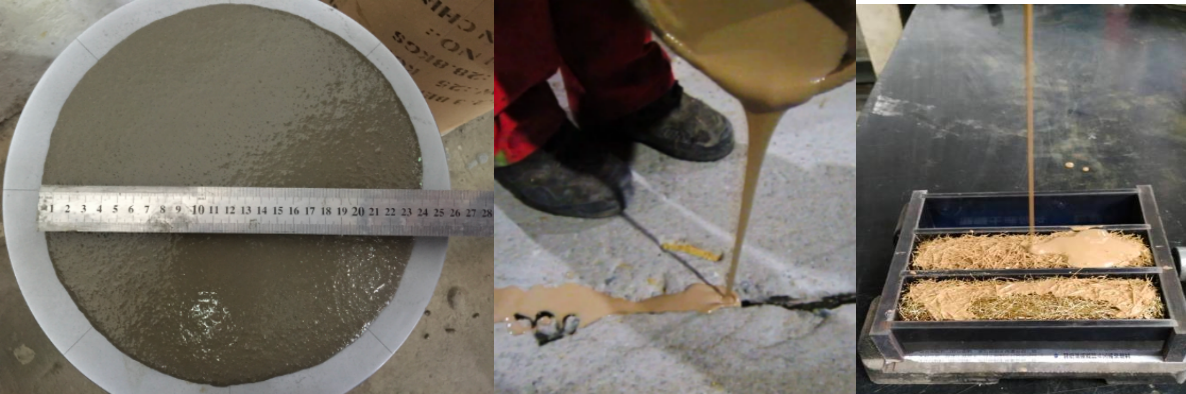
3.1 Infrastructure Rapid Repair: Roads, Bridges, and Airport Runways
The most commercially significant application of magnesium phosphate cement is as a rapid repair mortar for critical transportation infrastructure. Airport runways, highway bridge decks, port pavements, and urban arterial roads demand repair materials that can be placed, set, and returned to full traffic loading within a single maintenance window — often overnight. MPC delivers one-to-two-hour return-to-service performance that no Portland cement-based rapid repair mortar can match.
Airport authorities and highway agencies across Asia, Europe, and North America have adopted magnesium phosphate cement-based systems as their standard emergency repair specification. The strong interfacial bond of MPC to existing Portland cement concrete substrates — typically 2.0 to 4.0 MPa — produces durable, monolithic repair sections that perform reliably under heavy cyclic loading. Customers sourcing raw materials for infrastructure rapid repair mortar formulation are encouraged to explore ES CHEM's specialty chemical supply capabilities and contact our technical team for application support.
3.2 Industrial Flooring and Warehouse Restoration
In manufacturing plants, logistics warehouses, and cold storage facilities, floor damage directly translates to operational downtime. Conventional construction chemicals based on Portland cement or epoxy systems typically require 24 to 72 hours before forklift traffic can resume. Magnesium phosphate cement-based rapid repair mortar reduces this window to two to four hours, delivering substantial commercial value in high-throughput environments.
The 28-day compressive strength of 50–80 MPa, combined with excellent abrasion resistance and near-zero shrinkage, also makes MPC suitable for new-build industrial floor topping systems in high-wear environments — particularly where freeze-thaw cycling or chemical spill resistance is specified.
3.3 Nuclear Waste Encapsulation and Immobilization
Magnesium phosphate cement offers a technically superior matrix for the immobilization of low- and intermediate-level radioactive waste compared to ordinary Portland cement. MPC chemically bonds heavy metals and radionuclides within its struvite crystal lattice — rather than merely physically encapsulating them — resulting in significantly lower radionuclide leach rates, higher waste loading capacity, and better long-term containment performance.
Research programs and operational deployments in the United States, United Kingdom, and China have confirmed that MPC binder systems outperform conventional Portland cement grouts in nuclear waste management applications. The fast-setting cementitious material properties of magnesium phosphate cement additionally reduce worker radiation exposure time during waste immobilization operations.
3.4 Biomedical and Dental Cements
The biological affinity between struvite minerals and natural bone mineral has driven significant research into biomedical-grade magnesium phosphate cement formulations as biodegradable bone substitute materials and dental luting cements. MPC's fast-setting cementitious material behavior enables rapid intraoral or intraosseous setting, while its controlled biodegradability and osteoconductivity make it an attractive scaffold material for bone regeneration applications.
ES CHEM's pharmaceutical intermediates supply capabilities include high-purity magnesium and phosphate precursor compounds with full pharmacopeial documentation for customers developing biomedical-grade MPC formulations.
3.5 Heritage Conservation and Historic Building Restoration
In cultural heritage conservation, magnesium phosphate cement-based rapid repair mortar is gaining acceptance as a consolidant for historic masonry, stone monuments, and architectural ceramics. MPC's near-zero shrinkage, strong substrate adhesion, and compatibility with porous natural stone substrates make it technically superior to Portland cement-based repair mortars — which can induce damaging crystallization pressure and cause color mismatch in sensitive heritage structures.
4. Raw Material Components for MPC Formulation
The performance of any magnesium phosphate cement system is critically dependent on the quality and specification of its raw material components. The four principal ingredients are:
Dead-Burned Magnesia (DBM): The primary reactive component of MPC. Calcination temperature governs reactivity — 1500–1600°C yields moderate reactivity suitable for most construction chemical applications; above 1700°C produces lower reactivity, extending workable life. Typical specification: MgO ≥95%, CaO ≤1.5%, SiO₂ ≤1.5%, specific surface area 0.5–2.0 m²/g.
Monopotassium Phosphate (KH₂PO₄): The standard phosphate source for construction and infrastructure MPC formulations. Typical specification: K₂O ≥34%, P₂O₅ ≥52%, solubility >200 g/L at 20°C, heavy metals <10 ppm. ES CHEM supplies high-purity monopotassium phosphate as part of our fine chemical intermediates product range.
Borax (Na₂B₄O₇·10H₂O): The most widely used retarder for magnesium phosphate cement, controlling the exothermic reaction to provide workable time of 10–30 minutes. Standard addition: 5–10 wt% of MgO.
Supplementary Materials: Fly ash and silica fume are routinely incorporated into MPC rapid repair mortar formulations to reduce heat of reaction, improve workability, lower material cost, and enhance long-term durability.
5. Why Source MPC Raw Materials from ES CHEM?
ES CHEM (Shenyang East Chemical Science-Tech Co., Ltd.) is a China-based specialty chemical supplier with over a decade of experience providing inorganic and fine chemical raw materials to customers in the construction, pharmaceutical, electronics, and industrial sectors worldwide. Our supply capabilities for magnesium phosphate cement raw material components include:
High-purity phosphate compounds: Monopotassium phosphate and related phosphate salts for MPC formulation, available in technical, industrial, and food/pharmaceutical grades with full analytical certification
Magnesium intermediates: Dead-burned magnesia and related compounds with traceable manufacturing origin, ISO-certified quality management, and batch-to-batch consistency
Flexible supply: From laboratory sample quantities through to bulk container shipments; full export documentation and dangerous goods handling capability included
Integrated portfolio: Single-source procurement of MPC raw materials alongside BDO derivatives, pharmaceutical intermediates, and electronic chemicals reduces procurement complexity and vendor management burden
Technical support: Formulation guidance and application support for MPC system development from laboratory scale to commercial production
Magnesium phosphate cement stands at the intersection of materials science and practical engineering performance. Its ability to deliver fast-setting cementitious material strength within one to two hours of placement — combined with near-zero shrinkage, excellent substrate bond, broad chemical resistance, and an operating temperature range far exceeding ordinary Portland cement — makes MPC an indispensable material for infrastructure rapid repair, industrial maintenance, and specialty construction applications in 2025 and beyond.
As global infrastructure investment accelerates and the economic cost of extended operational closures becomes increasingly difficult to justify, demand for high-performance rapid repair mortar solutions based on magnesium phosphate cement will continue to grow. Whether your requirement is for MPC raw material components, high-purity phosphate and magnesium compounds for pharmaceutical intermediates or biomedical applications, or complementary construction chemicals, ES CHEM has the product expertise, supply network, and technical support to meet your needs.
Contact our team today for samples, technical data sheets, and competitive pricing on magnesium phosphate cement raw materials and our complete specialty chemicals portfolio.