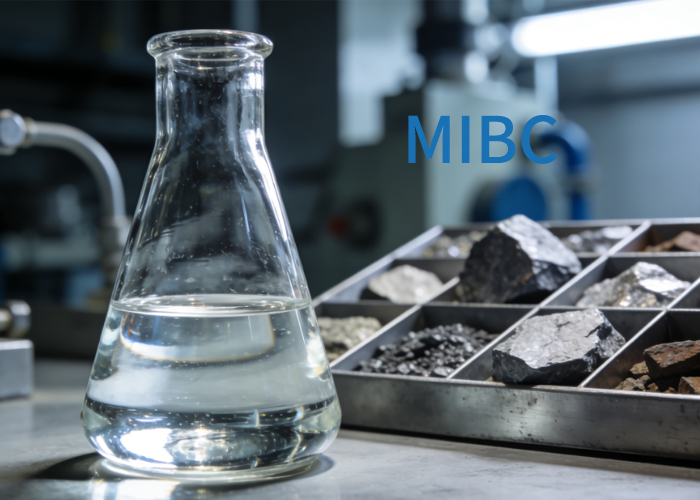
MIBC in Mineral Processing: Why Methyl Isobutyl Carbinol Remains the Industry Benchmark
In the global mining and mineral processing industry, flotation performance directly determines recovery efficiency and overall profitability. Among the various reagents used in flotation systems, frothers play a critical role in controlling bubble formation, stability, and selectivity. One of the most widely used and reliable frothers is methyl-isobutyl-carbinol, also known as isobutylmethylcarbinol or 4-methyl-2pentanol.
So, why does methyl-isobutyl-carbinol continue to dominate flotation applications across different ore types and operating conditions? The answer lies in its balanced performance, controllability, and adaptability to complex mineral systems.
Why Frothers Matter in Flotation Systems
Frothers are essential for generating stable yet mobile foam layers that enable mineral particles to attach to air bubbles and rise to the surface. The effectiveness of a frother determines:
Bubble size distribution
Foam stability
Selectivity between valuable minerals and gangue
Among available options, methyl-isobutyl-carbinol stands out because it produces moderately stable foam that is easy to control, making it ideal for a wide range of flotation circuits.
What Makes MIBC the Preferred Choice?
1. Balanced Foam Stability
Unlike overly strong frothers, isobutylmethylcarbinol creates a foam structure that is neither too persistent nor too fragile. This balance ensures:
Efficient mineral recovery
Reduced entrainment of unwanted particles
Easier downstream processing
In comparison, ester-based frothers such as DEP provide stronger foam persistence, while mixed higher alcohols (C6–C8) are more cost-effective but produce brittle foam. 4-methyl-2pentanol, however, offers a middle-ground solution that meets most operational needs.
2. Excellent Process Control
One of the biggest advantages of methyl-isobutyl-carbinol is its controllability. Operators can easily adjust dosage levels to fine-tune flotation performance without causing excessive froth buildup or instability.
This makes isobutylmethylcarbinol especially suitable for:
Large-scale industrial flotation plants
Continuous production systems
Operations requiring consistent performance
3. Adaptability to Complex Ore Conditions
Modern mining increasingly deals with complex ores and variable slurry conditions. In such cases, 4-methyl-2pentanol demonstrates strong adaptability across different pH ranges and mineral compositions.
While polyethylene glycol ethers (such as Dowfroth™ series) are known for wide pH applicability, methyl-isobutyl-carbinol remains a cost-effective and versatile baseline frother that can be combined with other reagents for enhanced performance.
Comparison with Other Frother Types
In practical applications, different frothers serve different purposes:
Polyethylene glycol ethers: Wide pH tolerance, suitable for complex slurries
Ester-based frothers (e.g., DEP): Strong foam persistence, ideal for fine particle flotation
Mixed alcohols (C6–C8): Low cost but less stable foam
Despite these options, isobutylmethylcarbinol continues to be the mainstream choice due to its reliability and cost-performance balance. Many flotation systems use 4-methyl-2pentanol either as a primary frother or in combination with other agents.
The Role of Collectors in Synergy with MIBC
While frothers like methyl-isobutyl-carbinol control foam behavior, collectors are responsible for selectively increasing mineral hydrophobicity. They adsorb onto mineral surfaces, enabling particles to attach to air bubbles.
The effectiveness of flotation depends on the synergy between collectors and frothers. In many systems, isobutylmethylcarbinol enhances the performance of collectors by providing optimal bubble conditions for particle attachment.
However, selecting the right combination requires:
Detailed mineralogical analysis
Understanding of ore surface properties
Laboratory flotation testing
Only through systematic evaluation can the most suitable reagent scheme—often involving 4-methyl-2pentanol—be identified.
Proven Performance in Industrial Applications
Real-world operations consistently validate the effectiveness of methyl-isobutyl-carbinol. From base metals to coal flotation, its performance has been proven in:
Stable recovery rates
Reduced reagent consumption
Improved operational efficiency
In regions with high humidity or variable environmental conditions, isobutylmethylcarbinol maintains consistent frothing behavior, ensuring reliable flotation results.
Cost Efficiency and Supply Stability
From a supply chain perspective, 4-methyl-2pentanol offers a strong advantage due to its widespread availability and stable production. Compared to specialty frothers, methyl-isobutyl-carbinol provides:
Competitive pricing
Scalable supply
Established logistics networks
For mining companies, this translates into lower operational risks and better cost control.
Conclusion: A Reliable Choice for Modern Flotation
Returning to the key question: is methyl-isobutyl-carbinol still relevant in today’s mineral processing industry?
The answer is a clear yes. As isobutylmethylcarbinol or 4-methyl-2pentanol, it continues to serve as a benchmark frother due to its balanced foam properties, excellent controllability, and adaptability to diverse flotation conditions.
For mining operations seeking stable, efficient, and cost-effective flotation performance, methyl-isobutyl-carbinol remains an essential component—not just an option, but a proven standard.