Hydroxypropyl Methyl Cellulose
- EASTCHEM
- China
- 15~20 days
- 99%min
- 9004-65-3
East Chemical provides high-quality Hydroxypropyl Methyl Cellulose (HPMC) designed to improve the performance of dry mix mortar systems while helping manufacturers optimize production costs and maintain product consistency.
With viscosity grades ranging from 300 to 75,000 mPa.s (Brookfield), our HPMC products are widely used in tile adhesives, wall putty, self-leveling compounds, gypsum products, repair mortars, EIFS systems, and other construction applications.
Products Description
Substandard cellulose ethers lead to water loss, sagging, cracking, and catastrophic field failures like tile debonding after freeze-thaw cycles.
Our Premium Grade HPMC solves these pain points. Engineered for high-performance building materials, our non-ionic cellulose ether delivers unmatched water retention, open time, and workability, cutting down your R&D trial-and-error costs.
To meet different formulation requirements, East Chemical also supplies:
HPMC (Hydroxypropyl Methyl Cellulose)
HEMC (Hydroxyethyl Methyl Cellulose)
HEC (Hydroxyethyl Cellulose)
Our technical team can recommend the most suitable cellulose ether grade based on your application, helping reduce trial-and-error costs and shorten product development cycles.
Prouducts Specification
| Item | Property |
| Methoxy | 19.0-30.0% |
| Hydroxypropyl | 4.0-12.0% |
| Gelation temperature | 60-90℃ |
| Moisture content | ≤5% |
| Ash content | ≤3.0% |
| PH value | 4.0-8.0 |
| Viscosity | 50--200000mPa.s |
Performance Features & Benefits
1. Superior Water Retention & Thermal Stability
The Benefit: Prevents rapid water loss into porous substrates, even in high-temperature environments.
Why it matters: Ensures complete cement hydration, eliminates shrinkage cracks, and extends open time for installers.
2. Rigorous Freeze-Thaw Resistance
The Benefit: East Chemical's HPMC tile adhesive formulations undergo strict freeze-thaw cycle testing.
Why it matters: Zero detachment, zero bubbling, and zero cracking. Your final mortar product achieves maximum durability and long-term structural reliability.
3. Outstanding Salt & pH Stability (pH 3.0 – 11.0)
The Benefit: Being a non-ionic cellulose ether, our HPMC is highly stable in the presence of metal salts or organic electrolytes.
Why it matters: Viscosity remains unaffected across acidic or highly alkaline conditions, giving you a predictable formula every time.
4. Controlled Thermal Gelation & Reversibility
The Benefit: Engineered surface activity enables HPMC to act as an efficient colloid protective agent, emulsifier, and dispersant. It gels at specific high temperatures and reverts seamlessly to its initial solution state upon cooling.
Applications
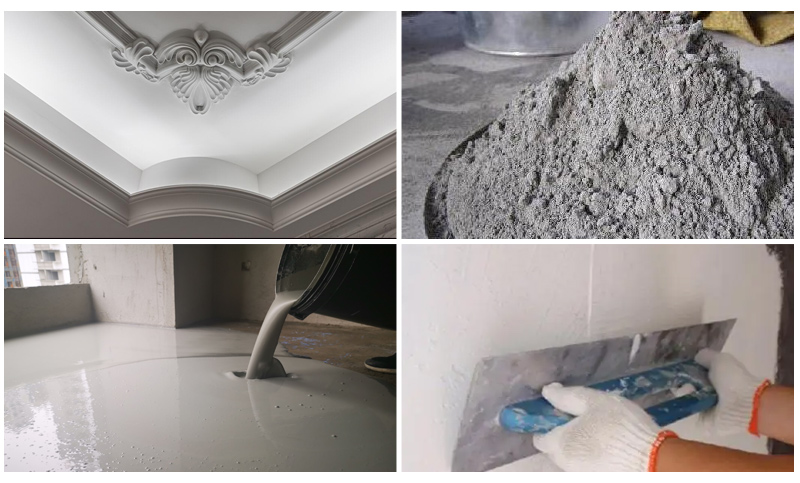
Tile Adhesives
HPMC improves water retention, open time, and bonding strength in tile adhesive formulations. It helps prevent tile slippage during installation and ensures reliable adhesion even under challenging construction conditions.
Wall Putty and Skim Coat
In putty powder applications, HPMC enhances workability, smoothness, and crack resistance. It allows easier application while improving surface finish and reducing material waste.
Dry Mix Mortar
As a key additive in dry mix mortar, HPMC provides excellent water retention and cohesion. It improves mortar consistency, extends working time, and enhances overall construction efficiency.
Self-Leveling Compounds
HPMC helps control viscosity and flow properties in self-leveling systems, ensuring smooth application and uniform surface leveling while minimizing segregation.
Gypsum-Based Products
For gypsum plaster, gypsum joint compounds, and gypsum-based decorative materials, HPMC improves water retention, adhesion, and workability, resulting in better application performance and surface quality.
EIFS and Insulation Mortars
In Exterior Insulation and Finishing Systems (EIFS), HPMC enhances bonding strength, flexibility, and durability, helping insulation systems withstand various environmental conditions.
Cement-Based Renders and Plasters
HPMC improves sag resistance, workability, and water retention, ensuring stable application and reducing the risk of cracking and shrinkage.
Paints and Coatings
As a thickener and stabilizer, HPMC provides excellent rheology control, suspension performance, and film-forming properties in water-based paints and coatings.
Household and Personal Care Products
HPMC is widely used in detergents, shampoos, liquid soaps, and other household chemical products as a thickener, emulsifier, and stabilizer to improve product consistency and user experience.
Industrial Applications
HPMC is also used in ceramics, synthetic resins, paper processing, adhesives, and other industrial formulations where thickening, water retention, dispersion, and film-forming properties are required.
Packaging
20kg valve paper bag packaging
Customized packaging available upon request
Industrial Dissolution Guidelines
To prevent clumping and ensure a homogenous mixture, we recommend three standard industrial preparation methods:
1. Hot Water Method: Charge 1/3 to 2/3 of the required water volume into the vessel and heat to above 80°C. Disperse HPMC powder uniformly into the hot water (it will not dissolve at this stage). Add the remaining cold water or ice water while stirring, and cool down to activate full dissolution and viscosity.
2. Dry Powder Blending Method: Premix HPMC powder thoroughly with an equivalent or larger volume of other dry ingredients (cement, sand, or gypsum) via dry-blending before adding water. This ensures separate particle wetting and prevents condensation clumps.
3. Organic Solvent Wetting Method: Pre-disperse or wet the HPMC powder using organic solvents like alcohol, glycol, or oils before introducing water. This allows for smooth, rapid, and lump-free dissolution.
FAQ
How does East Chemical’s HPMC perform in extreme weather, such as high temperatures or freeze-thaw cycles?
A: Our HPMC is engineered for extreme climate resilience.
In High Temperatures: Its superior water retention limits rapid evaporation, ensuring cement hydrates fully without cracking.
In Cold Climates: Mortars formulated with our HPMC successfully pass strict freeze-thaw cycle tests with zero tile detachment, zero bubbling, and zero cracking.
How do you ensure batch-to-batch quality consistency and regulatory compliance?
A: Quality stability is our core competitive advantage. Every batch of East Chemical HPMC undergoes strict raw material inspection, advanced automated production monitoring, and final Brookfield viscosity verification. We provide a Certificate of Analysis (COA) with every shipment to ensure your production line runs smoothly without any cost-heavy trial-and-error.
What is the difference between HPMC, HEMC, and HEC? Can you supply all of them?
A: Yes, we supply all three cellulose ethers to give your production lines maximum flexibility:
HPMC: Excellent balanced choice for general dry-mix mortars, wall putty, and coatings.
HEMC: Offers higher thermal gelation temperature, making it perform even better in extremely hot environments.
HEC: Primarily used in water-based latex paints for outstanding pseudoplasticity and biostability.